Taking responsibility – for bees and our future ❤

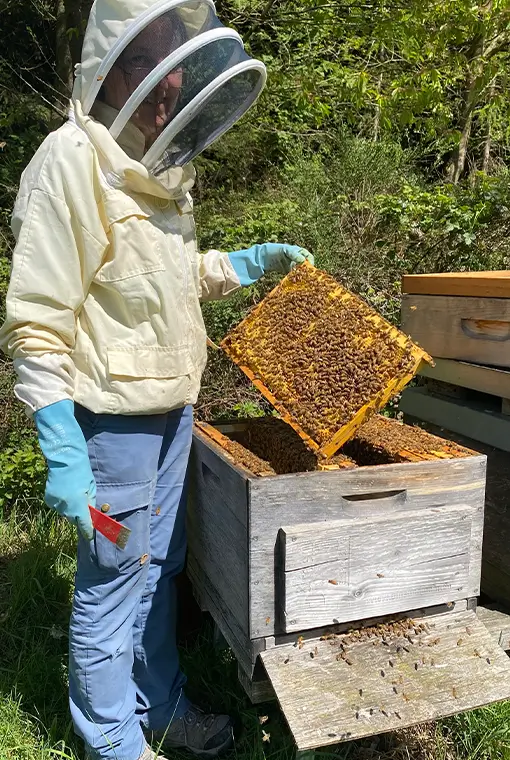
Bees are far more than just producers of honey: they play a key role in our ecosystem. As tireless pollinators, they safeguard the diversity of our food supply and contribute to the stability of nature. Around a third of all food is directly or indirectly dependent on their pollination services. Without bees, it is not just fruit and vegetables that would be missing from the supermarket – natural food chains would also be thrown out of balance, and the habitats of many animals would be at risk.

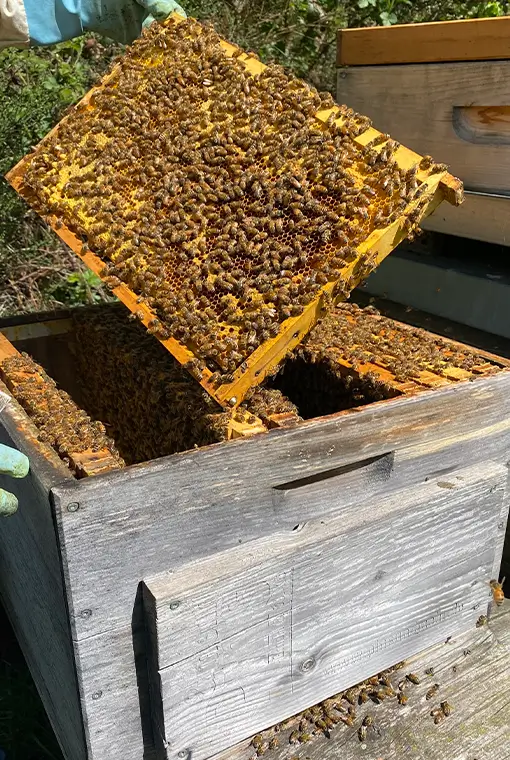
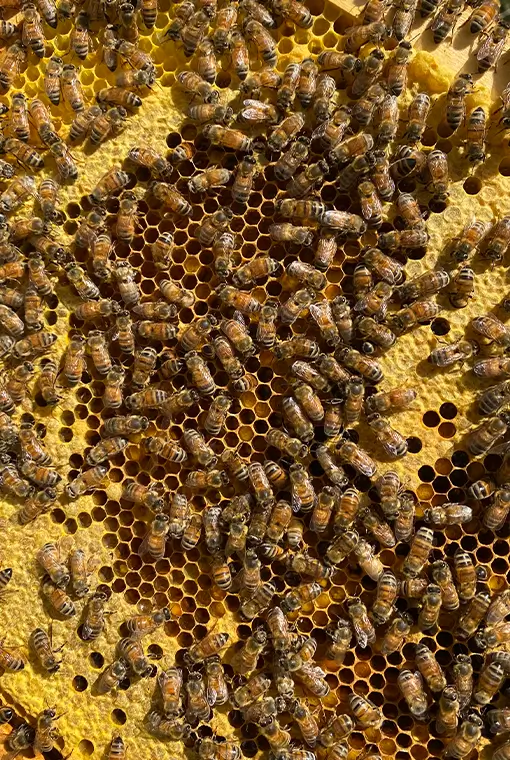
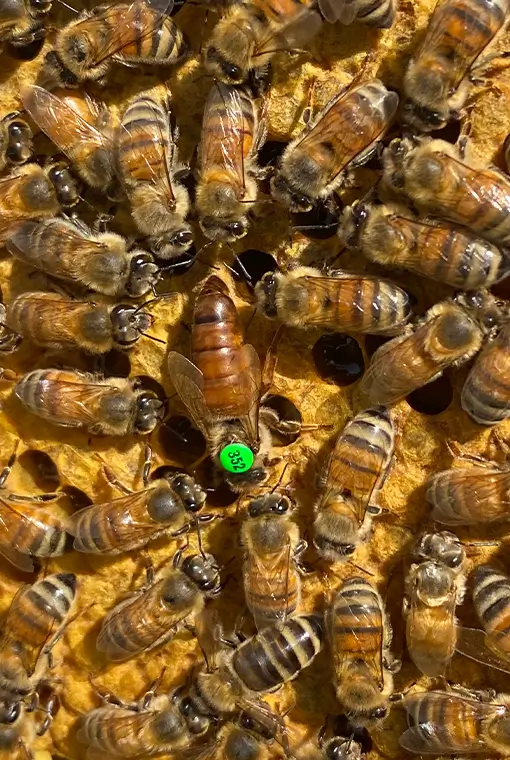
We know that without bees, a vital link between humans and nature is missing. That is why we have decided not just to stand by and watch, but to take active action. By sponsoring bees through Honiglandschaften in Affing, we are supporting two bee colonies. In doing so, we are helping to promote local biodiversity.

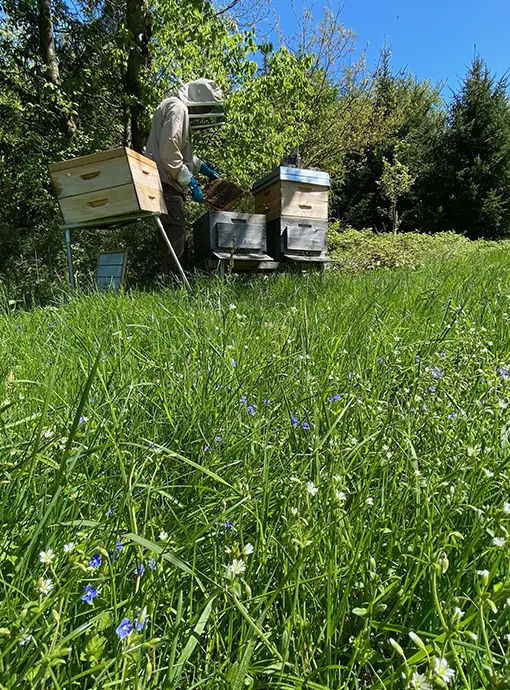
The beekeepers there work with great respect for the bees. They rely on natural methods, ensure healthy habitats and regard their bee colonies not as means of production, but as precious living creatures. We support this approach wholeheartedly. For we are convinced that only species-appropriate and mindful beekeeping can contribute to the long-term stability of our ecosystem. We need people who not only bring knowledge to the table, but also take responsibility – on both a small and a large scale.

Through our sponsorship, we aim not only to strengthen the protection of bees, but also to set an example: we are taking responsibility – so that biodiversity is preserved for the future. Every bee that is able to go about its business undisturbed is a benefit to us all.

Find out more about the philosophy behind Honiglandschaften >

“When I do something out of love, I’m happy to take responsibility for it.”

(Seibold, Klaus)

Bee Sponsorship: Pins & More – Background: Honey – Our Mission

News from our bee colonies

A look back at the 2026 honey harvest: Surprisingly good!

We must admit we were very surprised this year: despite the intense heat and extreme drought, our bee colonies were able to collect an incredible amount of nectar – and in some cases honeydew – from April to the end of June. The result was a honey yield well above average – in short, this year’s honey harvest was a resounding success.

However, our colonies are now suffering as a result of the ongoing weather conditions. The extreme drought has either caused the last of the forage plants to wither or prevented them from flowering in the first place. Supplies are secure: the fact that hardly any nectar is coming in is not a major concern at the moment, as our colonies have sufficient food reserves. The real problem is the lack of pollen: the bees urgently need fresh pollen to rear healthy winter bees. Only then will they have a chance of surviving the coming cold season.

Even though we humans are still a long way from thinking about winter in these summer temperatures, the bees have been fully preparing for it since the summer solstice: the drones have been driven out of the hives, colony sizes are slowly declining and the entire colony is switching to energy-saving mode.

An important milestone lies ahead in the coming days and weeks: we are focusing intensively on treating the Varroa mite whilst keeping a close eye on food supplies – even though, given the acute shortage of pollen, there is unfortunately little we can do. Every year, situations like this remind us anew just how little control we have over nature and how deeply we are all affected by extreme weather and climate change. We can only respond within very limited parameters – and hope that, thanks to the best possible care and support we provide, our bee colonies will stay healthy throughout the year.

08/2026

Annual Report 2024/25

Our bee sponsorship scheme

Honey Landscapes – Four international awards!
We are delighted to be entering our fourth year as bee sponsors and are continuing our successful partnership with the Bioland apiary. A special reason to celebrate: in 2024, their honeys won no fewer than four awards at the international organic honey competition BiolMiel – two gold medals for the spring blossom and dandelion honeys, and two silver medals for the forest & blossom and forest honeys – the only award-winning honeys from anywhere in Germany!

The annual report looks back on an eventful third year of sponsorship:
A strong start to the winter – Both colonies came through the winter of 2024/25 well, but one remained weaker throughout the year.
New queen – To strengthen the weaker colony, it was given a new queen and additional support in August/September.
Honey harvest – Plenty of spring blossom honey, no forest honey, but aromatic summer blossom honey instead.
A quiet year – Following the ‘cement honey’ year of 2024, 2025 passed without any major problems.

In the 2024/25 season, too, we would like to do our bit to ensure that the bees remain healthy and that beekeepers can continue to produce honey of the highest quality

Browse the annual report now

08/2025

Annual Report 2023/24

Our bee sponsorship scheme

We’re celebrating our third year as a bee sponsor!
We look back with pride on a successful partnership with the Bioland beekeeping business Honiglandschaften and look forward to continuing to play an active part in supporting the bees’ wellbeing in the coming year.

In our 2023/24 Annual Report, we offer fascinating insights into the second year of our hard-working bees. Find out what ‘cement honey’ is all about, what Varroa mites are, and why 2024 was a ‘crazy’ year.

Browse the annual report now

10/2024

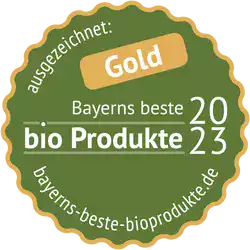
The Bioland apiary has once again been recognised in the ‘Bavaria’s Best Organic Products’ awards. This time, the gold medal has been awarded to Honiglandschaften’s honey balsamic vinegar.

Honiglandschaften has once again been recognised by bayerns-beste-bioprodukte.de – gold for Honiglandschaften Beekeeping

DIFFICULTIES in the summer of 2024

We are now entering our third year as bee sponsors with the Bioland apiary Honiglandschaften. Through this initiative, we continue to play an active role in protecting bees and preserving biodiversity. We regularly receive the latest news about the bees from Dr Steffen Watzke, one of the apiary’s owners.

The bees are already hard at work again, producing honey. This year, however, beekeepers in the region are facing a challenge with what is known as ‘cement honey’ in forest honey. Dr Steffen Watzke has provided us with an update on this situation in a recent report. He also discusses this difficult situation in an interesting feature on Bavarian Television:

‘In terms of workload, this year has been by far the most challenging in the history of our beekeeping business. This year, we have been struggling with a particular type of forest honey – known as ‘cement honey’. This crystallises in the combs after just a few days and can then no longer be extracted.’ – Quote from Dr Steffen Watzke – Bioland beekeeping business Honiglandschaften

07/2024

Bees in spring

The foundation for the development of our bee colony

Our sponsored colonies have come through the winter well and in good health, and were already stronger than average by March. Both colonies are healthy and lively! Thanks to the very mild winter, our bee colonies began breeding very early, meaning that by the time of the first inspection on 14 March, they were already much stronger than in previous years.

As everything has started to flower at the same time, the bees are currently finding an abundance of flowers – and therefore plenty of nectar and pollen. This means that the bees are well provided for and have already built up a good supply of honey!

Experience bees up close:

About the 24/7 bee camera

04/2024

Annual Report 2022/23

Our bee sponsorship scheme

Proud to present: We’re now in our second year as bee sponsors!
We’re proud to be part of the Bioland beekeeping business Honiglandschaften. And we’re looking forward to another year full of buzzing activity as bee sponsors.

In our 2022/23 Annual Report, you’ll learn lots of new things about these hard-working creatures: what a winter ball or a pollen panty is, and why the drones have to die in July.

Browse the annual report now

07/2023

There’s also some news from Honiglandschaften:

The Bioland apiary has once again been recognised in the ‘Bavaria’s Best Organic Products’ awards. This time, the gold medal has been awarded to Honiglandschaften’s honey balsamic vinegar.

Honiglandschaften has once again been recognised by bayerns-beste-bioprodukte.de – gold for Honiglandschaften Beekeeping

Preparing for Winter: Part 1

What the bee colonies do

Late summer is another critical period for bee colonies, as building up sufficient food reserves is just one of the many tasks they have to carry out in preparation for winter.

As early as July, after the summer solstice, the queen begins to lay fewer eggs, causing the number of worker bees in the colony to gradually decrease. From this point onwards, alongside the short-lived summer bees, an increasing number of long-lived winter bees are produced.

At the same time, the drones are now driven out of the hive. The worker bees harass the much larger drones by nipping, pinching and tugging at them to such an extent that the drones flee the hive in exasperation. Yet this spells certain doom for them, as drones do not gather food themselves and are dependent on being fed by the worker bees. Once they have left the hive, they are usually no longer allowed back through the flight hole and eventually starve to death. This may sound a little cruel, but it is vital for the survival of the colony, as the drones would consume too much valuable food during the winter.

In addition, in late summer, the worker bees collect not only nectar and pollen but also large quantities of propolis, which they use to seal and waterproof their hive, thereby preparing it for winter.

For all these tasks, it is important that the bee colony is strong and healthy in summer. This is because it is primarily the (still numerous) summer bees that carry out all these tasks; the winter bees, on the other hand, should be spared so that they can survive the winter well-nourished and in good health.

11/2022

Preparing for Winter: Part 2

The fight against the Varroa mite – what beekeepers need to do

Before the Varroa mite, which originates from Asia, was introduced to Europe, beekeepers did not have much left to do after the honey harvest – apart, of course, from ensuring that their bee colonies had enough food stores for the winter. But those days are long gone. Left untreated, bee colonies would not survive the winter – or, at the very latest, the following winter.

So why is the Varroa mite so dangerous to bee colonies?

Varroa mites primarily infest and damage bee brood, with the result that adult bees are already weakened and often unwell upon hatching and therefore die prematurely. Varroa mites reproduce at a rate of 1.1 to 1.3. Since the coronavirus pandemic, we have all learnt what an ‘r-value’ above 1 means: exponential growth! What’s more, absolutely every colony is infested!

However, bee colonies must not be treated for the Varroa mite before or during the honey harvest, as this could result in residues finding their way into the honey. The Varroa mite can therefore multiply unchecked in the bee colonies until summer. By July, at the time of the final honey harvest, the number of Varroa mites in the colony has already reached a critical level that could jeopardise the colony’s continued survival.

Without proper treatment by responsible beekeepers, bee colonies in Europe and around the world would not survive the Varroa mite and would die.

Unfortunately, to this day there is neither a vaccine against the Varroa mite (unlike the coronavirus) nor a Varroa-resistant honey bee. That is why our work as organic beekeepers in the height of summer consists primarily of effectively reducing the number of Varroa mites in the bee colonies to a safe level through a combination of natural measures and the application of organic acids. This is particularly important so that – as described above – healthy and long-lived winter bees can develop.

11/2022

❤

WE ARE AN OFFICIAL BEE SPONSOR

07/2022

❤

❤

By sponsoring a bee, you too can support your local bees. Become a bee sponsor with Honiglandschaften Bioland Beekeeping.

Find out more about the bee sponsorship scheme for your company here
> www.honiglandschaften.de

The bee sponsorship scheme in a nutshell

1 Achieving more together

We take it for granted that we should give something back from our financial success. That is why a portion of it goes towards our favourite project, the bee sponsorship scheme.

With your purchase, you and we are supporting:

  • organic beekeeping
  • close cooperation with the organic farming sector
  • the creation of bioregional value chains
  • a professional and knowledgeable beekeeping practice that respects animal welfare
  • a decent income for professional beekeepers

2 More bees in the region

Bees are incredibly important to our environment, as they pollinate a wide variety of wild and cultivated plants. In this way, they ensure the remarkable biodiversity and ecological balance of our planet.

As we care deeply about the environment and bees, we are committed, as an official bee sponsor, to the wellbeing and health of bees in our region.

Honey Landscapes:
‘A single drop of honey contains the entire life’s work of a bee – and the flavour of an entire landscape.’

3 More about honey landscapes

Honiglandschaften, together with its beekeeping business, has been a member of the Bioland Association from the very beginning and is inspected and certified annually.

Honey Landscapes:
‘Our vision is to meet the complex demands of modern beekeeping as effectively as possible through a holistic and scientifically based approach.’

“Our mission is to use high quality
to promote and strengthen appreciation for unique products such as honey and the many other wonderful bee products.”

Honiglandschaften’s products are synonymous with exclusivity and outstanding organic quality. As a result, they were awarded the silver medal in 2021 and the gold medal in 2023 at the ‘Bavaria’s Best Organic Products 2023’ competition.

more information about the award >

Honiglandschaften has once again been recognised by bayerns-beste-bioprodukte.de – gold for Honiglandschaften Beekeeping
Bavaria’s Best Organic Products 2021 – Awarded Silver – Honiglandschaften

❤ We do so much more ❤

♻

1 Environmentally friendly

As a manufacturer, we feel it is our duty to prevent plastic waste wherever we can.

Wherever possible, we avoid unnecessary individual packaging.

Our standard: bags made from plant-based raw materials that can be broken down under industrial composting conditions.
More information on packaging >

♺

2 Economic

We are investing in digitalisation and are therefore able to reduce both costs and the use of consumables.

We organise our logistics in such a way that transport capacity is utilised as efficiently as possible.

☺

3 Social

We are committed to upholding rights and complying with the law: product safety, employment law and environmental protection.

We are committed to doing our utmost to ensure product safety.

Pins & mehr GmbH & Co. KG, manufacturer of the TRIGGI® brand, is a member of amfori BSCI and Sedex.
Find out more at pinsundmehr.de >

Metal promotional items – Our commitment to our TRIGGI® shopping trolley release mechanisms

Would you like to enquire about your bespoke, durable
product?

Ihnen stehen folgende TRIGGI® Einkaufswagenlöser Varianten zur Verfügung: TRIGGI®Original, TRIGGI®plus, TRIGGI®NFC, TRIGGI®Öffner und TRIGGI®Premium.
Sprechen Sie mit uns. Wir beraten Sie gerne.

To inquiry